Tuesday, September 13, 2016

1048 LIFE OF Philip II

http://houseofhabsburg.net/spanish/philip-ii/


Philip II of Spain, 21 May 1527 – 13 September 1598

Philip II


(21 May 1527 – 13 September 1598)
Philip II, often considered to be one of the greatest of Spain’s monarchs, was the son of Charles V, Holy Roman Emperor and King of Spain and his cousin Isabella of Portugal, Philip was born on 21 May 1527 at the in the Palacio de Pimentel in Valladolid. It was by all accounts a difficult labour which his mother, Isabella, bore with stoicism. So conscious was she of bearing the heir to the Habsburg Empire, that when urged to cry out to ease her travail she responded “die I might, but cry out I will not”.

 The young Philip was brought up at the court of Castile by his Portuguese mother, he grew very close to his sisters María and Joanna. He was described by the Venetian ambassador Paolo Fagolo in 1563 as “slight of stature and round-faced, with pale blue eyes, somewhat prominent lip, and pink skin, but his overall appearance is very attractive.” He added “He dresses very tastefully, and everything that he does is courteous and gracious.”


On 12 November 1543, the then sixteen year old Philip was married to his double first cousin Maria Manuela of Portugal, the  daughter of John III of Portugal and Catherine of Austria . His father Charles V and his parents in law had chided Philip for his coldness toward Maria Manuela, Philip was by nature austere, cold and reserved. His coldness was in part due to his obsessive self-discipline. However, his correspondence with close family members reveal much warmth, in stark contradiction of his cold public image. Philip was short and slight in stature, invariably dressed in sober black, his sombre dress only relieved by the Order of the Golden Fleece, founded by his ancestor Philip the Good, Duke of Burgundy, which he habitually wore around his neck.
The marriage produced one child, the highly inbred Don Carlos, Prince of Asturias, who was born on 8 July 1545. Maria Manuela died some four days later from a postpartum haemorrhage. Carlos was deformed at birth and grew to be a mentally unstable character.
A second marriage was arranged for Philip to his 37 year old maternal cousin once removed, Mary I of England the only daughter of Henry VIII and Philip’s great aunt Catherine of Aragon. To raise Philip to the same rank as Mary, Charles V ceded the crown of Naples, as well as his claim to the Kingdom of Jerusalem, to his son. Mary had succeeded to the throne of England in 1553 on the death of her Protestant half-brother, Edward VI. There were several attempts by England’s Protestant element to overthrow the new Catholic queen, which led Mary to the decision to form an alliance with Catholic Spain, a decision which was unpopular with the English, who strongly disliked the idea of having a foreign king.
Following the execution of Mary’s Protestant rival, Lady Jane Grey, Philip duly arrived in England and the marriage was celebrated in July 1554 at Winchester Cathedral, Philip was eleven years younger than his bride. Philip and Mary appeared on coins together, with a single crown suspended between them as a symbol of joint reign. Mary, who had known little affection since her mother’s death, was in love for the first time in her life at the age of thirty-seven. Philip, much younger than his bride, unfortunately did not reciprocate her affection. As Ruy Gomez noted ‘The Queen is a lady of quality, but older than we thought, but his Highness is behaving so well and gives so many gifts that I’m sure both will be very pleased with each other, the king is trying to be as friendly as possible, he believes that his marriage was not made for flesh, but for the restoration of this area and preservation of those states’ (Flanders).
Philip’s father, Charles V abdicated in 1555 and Philip became king of Spain, the Netherlands, and all Spanish dominions in Italy and America. Philip reactivated the Spanish Inquisition in an attempt to deal with the growth of Protestantism in Europe. Mary believed herself pregnant, but was humiliated when the desperately awaited child did not arrive at the due time and she had to accept that she had been mistaken. The Queen had in fact, suffered from a phantom pregnancy. Philip, never particularly enamoured of her, left England shortly after, leaving Mary desolate and deserted and pathetically yearning for his return.
Philip returned briefly to enlist England’s support in a war against France, which led to the loss of Calais, which had been an English possession since the conquests of Edward III, a source of great sadness to the Queen. She was reported to have said at the time “When I am dead and opened you will find Calais written on my heart.” Mary again believed herself pregnant of a child which would continue her work and ensure a Catholic succession. It turned out to be a tumour.
Philip, realizing that the succession of Mary, Queen of Scots to the English throne would be disadvantageous to Spain, since she was at that time married to the Dauphin of France, had to be avoided at all costs. He persuaded Mary to name Elizabeth as her successor and marry her to a Spaniard. Elizabeth resisted such a marriage and the Queen could not, in good conscience, force her to do so. Mary died, deserted again by her husband, on 17 November, 1558, of either uterine or ovarian cancer. On receipt of the news, Philip wrote “I felt a reasonable regret for her death.” .
Reluctant to sever his tie with England, Philip proposed marriage to England’s new sovereign, his sister-in-law, Elizabeth I , but his offer was diplomatically declined.


Philip's third wife, Elisabeth of Valois

 Philip married for a third time to Elisabeth of Valois, the pretty daughter of King Henri II of France in 1559. He was enchanted by his 14-year-old bride, and despite their age difference, Elisabeth wrote to her mother, that she considered herself to be fortunate to have married so charming a prince. The marriage produced the following issue:-

 (ii) Isabella Clara Eugenia of Spain, (12 August 1566 – 1 December 1633), who married Albert VII, Archduke of Austria, had three children, all of whom died in infancy

/////////////////////////

1047 Isabella of Portugal MOTHER OF PHILIP ii

File:Isabella of Portugal by Titian.jpg


//////////////////////
sabella of Portugal (Portuguese: Isabel; 24 October 1503 – 1 May 1539) was an Infanta of Portugal, by birth, and a Holy Roman Empress, Queen of Germany, Italy, Spain, Naples and Sicily, Duchess of Burgundy etc. as the spouse of Charles V, Holy Roman Emperor. She was the daughter of Manuel I of Portugal and Maria of Aragon. She served as regent of Spain during the absence of her spouse for long periods.

 sabella was the second child and eldest daughter of King Manuel I of Portugal and his second wife, Infanta Maria of Castile and Aragon. She was named after her maternal grandmother, Isabella I of Castile, and her aunt Isabella, Princess of Asturias, who had been her father's first wife.
Through her father, she was a granddaughter of Infante Ferdinand, Duke of Viseu (the second son of King Edward of Portugal and brother of King Afonso V of Portugal) and Infanta Beatrice, the daughter of John, Constable of Portugal (brother of King Edward). Through her mother she was a granddaughter of Isabella I of Castile and Ferdinand II of Aragon.
Isabella was second-in-line to the throne until the birth of her brother Louis in 1506. However, as the oldest daughter of Manuel I of Portugal, she was a rather attractive party. She married her first cousin, Charles V, Holy Roman Emperor, the son of Joanna of Castile and Philip the Handsome, Duke of Burgundy, who as Holy Roman Emperor, King of Spain, Archduke of the Habsburg dominions, titular Duke of Burgundy, and ruler of the Netherlands and the Spanish empire in the Americas and the Mediterranean and Italy was one of the most powerful men of his time.


In 1521 Isabella's father died and her brother succeeded to the throne as king John III. The marriage negotiations between the Portuguese and Spanish began almost immediately. It was agreed that the new king would marry Catherine of Austria, Charles V's younger sister. The union between Charles and his cousin Isabella had been proposed by the parliaments of both Castile and Aragon. Charles agreed to marry the Infanta Isabella purely out of political reasons.[1] The Infanta travelled to Seville where the wedding took place on 10 March 1526 in the palace of Alcázar of Seville.[2][3] With Isabella also came a huge dowry to the Spanish finances. Although it was a political union, the marriage proved to be a love-match. Records say that during their honeymoon "when [Charles and Isabella] are together, although there are many people around, they do not notice anyone else; they talk and laugh, and nothing else distracts them."
Isabella also proved to be a competent consort; she served as regent of Spain during her husband's absences, between 1529–1532 and 1535–1539. She was noted for her intelligence and beauty.


1046 Philip II of Spain SON OF Charles V of the Holy Roman Empire, and his wife, Infanta Isabella of Portugal,


 File:Portrait of King Philip II of Spain, in Gold-Embroidered Costume with Order of the Golden Fleece.jpg

///////////////////////

Philip II of Spain (Spanish: Felipe II; 21 May 1527 – 13 September 1598), called "the Prudent" (el Prudente), was King of Spain[a] (1556–98), King of Portugal (1581–98, as Philip I, Filipe I),[1] King of Naples and Sicily (both from 1554), and during his marriage to Queen Mary I (1554–58) jure uxoris King of England and Ireland.[2] He was also Duke of Milan.[3] From 1555, he was lord of the Seventeen Provinces of the Netherlands.
Known in Spain as "Felipe el Prudente" ('"Philip the Prudent'"), his empire included territories on every continent then known to Europeans, including his namesake the Philippine Islands. During his reign, Spain reached the height of its influence and power. This is sometimes called the Golden Age. The expression, "the empire on which the sun never sets," was coined during Philip's time to reflect the extent of his dominion.
During Philip's reign there were separate state bankruptcies in 1557, 1560, 1569, 1575, and 1596. This was partly the cause for the declaration of independence which created the Dutch Republic in 1581. A devout Catholic, Philip is also known for organising a huge naval expedition against Protestant England in 1588, known usually as the Spanish Armada, which was unsuccessful, mostly due to storms and grave logistical problems.
Philip was described by the Venetian ambassador Paolo Fagolo in 1563 as "slight of stature and round-faced, with pale blue eyes, somewhat prominent lip, and pink skin, but his overall appearance is very attractive." The Ambassador went on to say "He dresses very tastefully, and everything that he does is courteous and gracious."[4]


The son of Charles V of the Holy Roman Empire, and his wife, Infanta Isabella of Portugal, Philip was born in the Spanish capital of Valladolid on 21 May 1527 at Palacio de Pimentel owned by Don Bernardino Pimentel (the first Marqués de Távara). The culture and courtly life of Spain were an important influence in his early life. He was tutored by Juan Martínez Siliceo – the future Archbishop of Toledo. Philip displayed reasonable aptitude in arms and letters alike. Later he would study with more illustrious tutors, including the humanist Juan Cristóbal Calvete de Estrella. Philip, though he had good command over Latin, Spanish and Portuguese, never managed to equal his father, Charles V, as a polyglot. Despite being also a German archduke from the House of Habsburg, Philip was seen as a foreigner in the Holy Roman Empire. The feeling was mutual. Philip felt himself to be culturally Spanish; he had been born in Spain and raised in the Castilian court, his native tongue was Spanish, and he preferred to live in Spain. This would ultimately impede his succession to the imperial throne.[5]
In April 1528, when Philip was eleven months old, he received the oath of allegiance as heir to the crown from the Cortes of Castile, and from that time until the death of his mother Isabella in 1539, Philip was raised in the royal court of Castile under the care of his mother, and one of her Portuguese ladies, Dona Leonor de Mascarenhas, to whom he was devotedly attached. Philip was also close to his two sisters, María and Juana, and to his two pages, the Portuguese nobleman Rui Gomes da Silva and Luis de Requesens, the son of his governor Juan de Zúñiga. These men would serve Philip throughout their lives, as would Antonio Pérez, his secretary from 1541.
Philip's martial training was undertaken by his governor, Juan de Zúñiga, a Castilian nobleman who served as the commendador mayor of Castile. The practical lessons in warfare was overseen by the Duke of Alba during the Italian Wars. Philip was present at the Siege of Perpignan in 1542, but did not see action as the Spanish army under Alba decisively defeated the besieging French forces under the Dauphin of France. On his way back to Castile, Philip received the oath of allegiance of the Aragonese Cortes at Monzón. His political training had begun a year previously under his father, who had found his son studious, grave, and prudent beyond his years, and having decided to train and initiate him in the government of Spain. The king-emperor's interactions with his son during his stay in Spain convinced him of Philip's precocity in statesmanship, and so he determined to leave in his hands the regency of Spain in 1543. Philip, who had previously been made the Duke of Milan in 1540, began governing the most extensive empire in the world at the young age of sixteen.
Charles left Philip with experienced advisors—notably the secretary Francisco de los Cobos and the general Duke of Alba. Philip was also left with extensive written instructions which emphasised "piety, patience, modesty, and distrust." These principles of Charles were gradually assimilated by his son, who would grow up to become grave, self-possessed and cautious. Personally, Philip spoke softly, and had an icy self-mastery; in the words of one of his ministers, "he had a smile that cut like a sword

1045 Charles V, Holy Roman Emperor


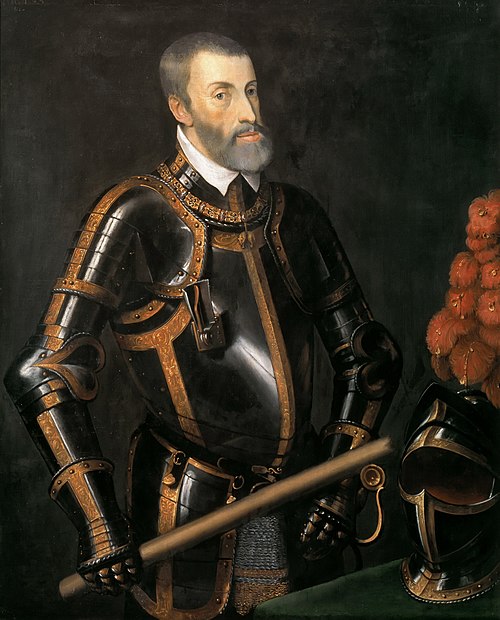
 Charles V, Holy Roman Emperor

FROM 

House of Valois-Burgundy

Habsburg Netherlands

 and the Spanish colonies in the Americas and Asia. As a result, his domains spanned nearly four million square kilometers[3] and were the first to be described as "the empire on which the sun never sets".[4]

1044 Charles V, Holy Roman Emperor


File:Elderly Karl V.jpg


Charles V 
 Charles was the heir of three of Europe's leading dynasties: the Houses of Valois-Burgundy (Netherlands), Habsburg (Holy Roman Empire), and Trastámara (Spain). He inherited the Burgundian Netherlands and the Franche-Comté as heir of the House of Valois-Burgundy. From his own dynasty, the Habsburgs, he inherited Austria and other lands in central Europe. He was also elected to succeed his Habsburg grandfather, Maximilian I, as Holy Roman Emperor, a title held by the Habsburgs since 1440. From the Spanish House of Trastámara, he inherited the crowns of Castile, which was in the process of developing a nascent empire in the Americas and Asia, and Aragon, which included a Mediterranean empire extending to Southern Italy. Charles was the first king to rule Castile and Aragon simultaneously in his own right, and as a result he is sometimes referred to as the first King of Spain.[5] The personal union, under Charles, of the Holy Roman Empire with the Spanish Empire resulted in the closest Europe would come to a universal monarchy since the death of Louis the Pious.


(Spanish: Carlos; French: Charles; German: Karl; Dutch: Karel; Italian: Carlo)[a] (24 February 1500 – 21 September 1558) was ruler of both the Spanish Empire from 1516 and the Holy Roman Empire from 1519, as well as of Habsburg Netherlands from 1506. He voluntarily stepped down from these and other positions by a series of abdications between 1554 and 1556. Through inheritance, he brought together under his rule extensive territories in western, central, and southern Europe, and the Spanish colonies in the Americas and Asia. As a result, his domains spanned nearly four million square kilometers[3] and were the first to be described as "the empire on which the sun never sets".[4]
Charles was the heir of three of Europe's leading dynasties: the Houses of Valois-Burgundy (Netherlands), Habsburg (Holy Roman Empire), and Trastámara (Spain). He inherited the Burgundian Netherlands and the Franche-Comté as heir of the House of Valois-Burgundy. From his own dynasty, the Habsburgs, he inherited Austria and other lands in central Europe. He was also elected to succeed his Habsburg grandfather, Maximilian I, as Holy Roman Emperor, a title held by the Habsburgs since 1440. From the Spanish House of Trastámara, he inherited the crowns of Castile, which was in the process of developing a nascent empire in the Americas and Asia, and Aragon, which included a Mediterranean empire extending to Southern Italy. Charles was the first king to rule Castile and Aragon simultaneously in his own right, and as a result he is sometimes referred to as the first King of Spain.[5] The personal union, under Charles, of the Holy Roman Empire with the Spanish Empire resulted in the closest Europe would come to a universal monarchy since the death of Louis the Pious.
Because of widespread fears that his vast inheritance would lead to the realization of a universal monarchy and that he was trying to create a European hegemony, Charles was the object of hostility from many enemies.[6] His reign was dominated by war, and particularly by three major simultaneous conflicts: the Habsburg-Valois Wars with France, the struggle to halt the Ottoman advance, and the Protestant Reformation resulting in conflict with the German princes.[7] The wars with France, mainly fought in Italy, resulted in recovery of territory lost at the beginning of his reign and included the decisive defeat and capture of Francis I of France at the Battle of Pavia in 1525. France recovered and the wars continued for the remainder of Charles's reign. Enormously expensive, they led to the development of the first modern professional army in Europe, the Tercios.
The struggle with the Ottoman Empire was fought in Hungary and the Mediterranean. After seizing most of eastern and central Hungary in 1526, the Ottomans’ advance was halted at their failed Siege of Vienna in 1529. A lengthy war of attrition, conducted on his behalf by his younger brother Ferdinand, continued for the rest of Charles's reign. In the Mediterranean, although there were some successes, Charles was unable to prevent the Ottomans’ increasing naval dominance and the piratical activity of the Barbary Corsairs. Charles opposed the Reformation and in Germany he was in conflict with the Protestant Princes of the Schmalkaldic League who were motivated by both religious and political opposition to him. He could not prevent the spread of Protestantism and although he won a decisive victory against the Princes at the Battle of Mühlberg, 1547, he was ultimately forced to concede the Peace of Augsburg of 1555, which divided Germany on confessional lines.
While Charles did not typically concern himself with rebellions, he was quick to put down three particularly dangerous rebellions in the vital territories of Castile, the Frisian lands, and later in his reign in the port city of Ghent. Once the rebellions were quelled the essential Castilian and Burgundian territories remained mostly loyal to Charles throughout his rule.
Charles’s Spanish dominions were the chief source of his power and wealth, and they became increasingly important as his reign progressed. In the Americas, Charles sanctioned the conquest by Castillian conquistadors of the Aztec and Inca empires. Castillian control was extended across much of South and Central America. The resulting vast expansion of territory and the flows of South American silver to Castile had profound long term effects on Spain.
Charles was only 56 when he abdicated, but after 34 years of energetic rule he was physically exhausted and sought the peace of a monastery, where he died at the age of 58. Upon Charles’s abdications, the Holy Roman Empire was inherited by his younger brother Ferdinand, who had already been given the Austrian lands in 1521. The Spanish Empire, including the possessions in the Netherlands and Italy, was inherited by Charles’s son Philip II. The two empires would remain allies until the 18th century.

1043 Habsburg Imperial states Seventeen Provinces

Seventeen Provinces was a term applied to the Imperial states of the Habsburg Netherlands

 in the 15th and 16th century. They roughly covered the Low Countries, i.e. the current Netherlands, Belgium, and Luxembourg, plus most of the modern French department of Nord including Artois, French Flanders, and French Hainaut. Also enclosed in this area were semi-independent fiefdoms, mainly ecclesiastical ones, such as Liège, Cambrai and Stavelot-Malmedy.
The Seventeen Provinces arose from the Burgundian Netherlands, a number of fiefs held by the House of Valois-Burgundy and inherited by the Habsburg dynasty in 1482, from 1556 held by Habsburg Spain. Since 1512 the Provinces formed the major part of the Burgundian Circle. In 1581 the Seven United Provinces seceded to form the Dutch Republic.

1042-1 Habsburg Netherlands

Habsburg Netherlands


Habsburg Netherlands is the collective name of Holy Roman Empire fiefs in the Low Countries held by the House of Habsburg and later by the Spanish Empire, also known as the Spanish Netherlands. The rule began in 1482, when after the death of the Valois-Burgundy duke Charles the Bold the Burgundian Netherlands fell to the Habsburg dynasty by the marriage of Charles's daughter Mary of Burgundy to Archduke Maximilian I of Austria.
Then known as Seventeen Provinces, they were held by the Spanish Empire from 1556, and are therefore also known as the Spanish Netherlands from that time on. In 1581, the Seven United Provinces seceded to form the Dutch Republic; the remaining Spanish Southern Netherlands eventually passed on to Habsburg Austria. Finally the Austrian Netherlands were annexed by the French First Republic in 1795.


1042 House of Habsburg most influential royal houses of Europe.

The House of Habsburg (/ˈhæps.bɜːrɡ/; German pronunciation: [ˈhaːps.bʊʁk]), or House of Austria,[1] was one of the most influential royal houses of Europe. The throne of the Holy Roman Empire was continuously occupied by the Habsburgs between 1438 and 1740. The house also produced emperors and kings of the Kingdom of Bohemia, Kingdom of England (Jure uxoris King), Kingdom of France (Queen consort), Kingdom of Germany, Kingdom of Hungary, Empire of Russia, Kingdom of Croatia, Second Mexican Empire, Kingdom of Ireland (Jure uxoris King), Kingdom of Portugal, and Habsburg Spain, as well as rulers of several Dutch and Italian principalities.[dubious ] From the sixteenth century, following the reign of Charles V, the dynasty was split between its Austrian and Spanish branches. Although they ruled distinct territories, they nevertheless maintained close relations and frequently intermarried.
The House takes its name from Habsburg Castle, a fortress built in the 1020s in present-day Switzerland by Count Radbot of Klettgau, who chose to name his fortress Habsburg. His grandson Otto II was the first to take the fortress name as his own, adding "Count of Habsburg" to his title. The House of Habsburg gathered dynastic momentum through the 11th, 12th, and 13th centuries.
By 1276, Count Radbot's seventh generation descendant Rudolph of Habsburg had moved the family's power base from Habsburg Castle to the Duchy of Austria. Rudolph had become King of Germany in 1273, and the dynasty of the House of Habsburg was truly entrenched in 1276 when Rudolph became ruler of Austria, which the Habsburgs ruled until 1918.
A series of dynastic marriages[2] enabled the family to vastly expand its domains to include Burgundy, Spain and its colonial empire, Bohemia, Hungary, and other territories. In the 16th century, the family separated into the senior Habsburg Spain and the junior Habsburg Monarchy branches, who settled their mutual claims in the Oñate treaty.
The House of Habsburg became extinct in the 18th century. The senior Spanish branch ended upon the death of Charles II of Spain in 1700 and was replaced by the House of Bourbon. The remaining Austrian branch became extinct in the male line in 1740 with the death of Holy Roman Emperor Charles VI, and completely in 1780 with the death of his eldest daughter Maria Theresa of Austria. It was succeeded by the Vaudemont branch of the House of Lorraine. The new successor house styled itself formally as House of Habsburg-Lorraine (German: Habsburg-Lothringen), although it was often referred to as simply the House of Habsburg.

1041 Habsburg Netherlands

Habsburg Netherlands is the collective name of Holy Roman Empire fiefs in the Low Countries held by the House of Habsburg and later by the Spanish Empire, also known as the Spanish Netherlands. The rule began in 1482, when after the death of the Valois-Burgundy duke Charles the Bold the Burgundian Netherlands fell to the Habsburg dynasty by the marriage of Charles's daughter Mary of Burgundy to Archduke Maximilian I of Austria.
Then known as Seventeen Provinces, they were held by the Spanish Empire from 1556, and are therefore also known as the Spanish Netherlands from that time on. In 1581, the Seven United Provinces seceded to form the Dutch Republic; the remaining Spanish Southern Netherlands eventually passed on to Habsburg Austria. Finally the Austrian Netherlands were annexed by the French First Republic in 1795.

1040 The Bourbons in SPAIN

http://www.donquijote.org/culture/spain/history/the-bourbons

The Bourbons


////////////////////////////

The Bourbons in Spain. Philip V was the first Bourbon king to rule Spain, and his reign marked the beginning of a new era in Spanish history.


Philip V was the first Bourbon king to rule Spain, and his reign marked the beginning of a new era in Spanish history. Ties with France were of course strengthened, and the court acquired a distinctly European air, characterised by the ideas of the Enlightenment. French influence, however, would only last about a hundred years, for in 1789 Spain closed the border, fearing that the ideals of the French Revolution could spread and seal the fate of her own Bourbon monarchy. Ten years later Napoleon would overthrow the last republican government (the Directory) in France in order to establish his own rule, under which the map of Europe would again be significantly transformed.
In 1808 Napoleon invaded Spain, forcing both King Charles IV and his son Ferdinand VII to abdicate in favour of Napoleon's brother, Joseph Bonaparte. Refusal to accept Bonaparte by the Spanish resistance led to the War of Independence (known in English as the Peninsular War because of Portugal's participation). As war was being waged, a national assembly was held in Cadiz to proclaim a constitution (1812) that would mark the end of absolute rule and the establishment of a parliamentary government for the very first time in Spanish history.
When the war came to an end and Napoleon was finally defeated in 1814, Ferdinand VII was restored to the throne, yet his first decision was to abolish the liberal constitution. As a result of his reactionary proposals, Spain would be immersed once again in a highly conflicting period rife with civil wars.
Ferdinand had set aside the Salic law that excluded females from dynastic succession, in favour of his daughter Isabella. Upon Ferdinand's death, his wife María Cristina became Queen regent on behalf of Isabella, who would be crowned Queen of Spain in 1833. Isabella II was welcomed by the liberals (known as cristinos or isabelinos), while Ferdinand's brother Don Carlos received the support of the conservatives (thus known as carlistas). The ensuing Carlist Wars, which involved other European forces such as British, French and Portuguese troops, would span almost fifty years, extending beyond Isabella's deposition in 1868.
Isabella's son Alfonso XII was proclaimed king in 1874 and two years later the wars would be declared officially over, despite brief periods of renewed insurgency in the early 20th century. After an interval of forty-three years, in 1975 the Bourbon monarchy was restored in Spain in the figure of King Juan Carlos I and his heir, Prince Philip who followed on the throne after his father's abdication in the year 2014.


1033 Bonaparte Family

Bonaparte Family, Italian Buonaparte, a family made famous by Napoleon I, emperor of the French (1804–1814/15). The French form Bonaparte was not commonly used, even by Napoleon, until after the spring of 1796. The original name was Buonaparte, which was borne in the early Middle Ages by several distinct families in Italy. One of these, which settled at Florence before the year 1100, was divided in the 13th century into the two branches of San Miniato and Sarzana. A member of this latter, Francesco Buonaparte, emigrated in the middle of the 16th century to Corsica, where his descendants continued to occupy themselves with the affairs of law and the magistracy.

1032 Condé family

Condé family, important French branch of the house of Bourbon, whose members played a significant role in French dynastic politics. The line began with Louis I de Bourbon, prince de Condé (1530–69), a military leader of the Huguenots in France’s Wars of Religion. The family’s most prominent member was the 4th prince de Condé, Louis II de Bourbon, one of Louis XIV’s greatest generals. The princely line died out when Louis-Antoine-Henri de Bourbon-Condé (1772–1804), duc d’Enghien and sole heir of the 9th and last prince de Condé (Louis-Henri-Joseph), was falsely arrested and, on Napoleon’s orders, shot for treason.

1031 House of Guise

House of Guise, Noble French Roman Catholic family that played a major role in French politics during the Reformation. Claude de Lorraine (1496–1550) was created the 1st duke de Guise in 1527 for his service to Francis I in the defense of France. Claude’s sons François, 2nd duke de Guise, and Charles, cardinal de Lorraine (1524–1574), gained great power during the reign of Francis II. Supported by Spain and the papacy, their persecution of the Huguenots led to the unsuccessful Amboise Conspiracy (1560), an attempted assassination of the leaders of the Guise party and transfer of power to the house of Bourbon. The Guise-led massacre of a Huguenot congregation at Vassy precipitated the Wars of Religion, in which Henri I, 3rd duke de Guise, was a prominent leader. Charles de Lorraine, 4th duke de Guise (1571–1640), lived through the rapid decline of the family’s power. Henri II, 5th duke de Guise, tried unsuccessfully to revive the family’s power; the direct line expired with the death of his grand-nephew in 1675.

1030 House of Bernadotte

House of Bernadotte, royal dynasty of Sweden, from 1818. The name derives from a family of old lineage of Béarn, France, whose earliest known member (17th century) owned an estate in Pau known as “Bernadotte.”

 
House of Bernadotte, royal dynasty of Sweden, from 1818. The name derives from a family of old lineage of Béarn, France, whose earliest known member (17th century) owned an estate in Pau known as “Bernadotte.”
In 1810, Jean-Baptiste-Jules Bernadotte, a celebrated marshal of France under Napoleon, was elected crown prince of Sweden, went to Stockholm, acted officially as regent during the illnesses of the aged, childless king Charles XIII, and in 1818 became king, as Charles XIV John. Succeeding rulers were his son Oscar I (reigned 1844–59), Charles XV (1859–72), Oscar II (1872–1907), Gustav V (1907–50), Gustav VI Adolf (1950–73), and Charles XVI Gustav (or Carl XVI Gustaf; 1973– ).

1029 house of Martin

Martin Family, French lacquerware artists of the period of Louis XV. The four brothers—Guillaume (d. 1749), Julien (d. 1752), Robert (b. 1706—d. 1765), and Étienne-Simon (d. 1770)—are remembered for perfecting the composition and application of vernis Martin, a lacquer substitute named after them, patented by Guillaume and Robert in 1730. In 1748 their factory became part of the Royal Factory of Furnishings to the Crown. Among their commissions were coaches and rooms at Versailles. Their name is also associated with vernis Martin fans, although it is not known if they actually made these fans. Robert’s son Jean-Alexandre (b. 1738) worked for Prussia’s Frederick II the Great at Potsdam.

1028 house of Gobelin


Gobelin Family, , (died 1476) who ran a factory in the Faubourg Saint-Marcel just southeast of Paris, discovered a scarlet dyestuff and spared no expense to exploit his creation. His descendants seem to have given up dyeing by the end of the 16th century; some of them bought titles of nobility and offices in the financial administration or in royal councils, as did Balthasar Gobelin (d. 1617), seigneur de Brie-Comte-Robert from 1601. The factory, lent to King Henry IV in 1601 and only then devoted to making tapestries, was purchased for King Louis XIV in 1662 and devoted to general upholstery until its closing in 1694. Reopened for tapestry in 1697, it was temporarily closed during the Revolutionary period but was reopened again by Napoleon. Carpets as well as tapestry have been produced since 1826.

1027 Lusignan Family, noble family of Poitou (a province of western France)

Lusignan Family, noble family of Poitou (a province of western France) that provided numerous crusaders and kings of Jerusalem, Cyprus, and Lesser Armenia. A branch of the family became counts of La Marche and Angoulême and played a role in precipitating the baronial revolt in England against King Henry III. The castle of Lusignan is associated with the medieval legend of Mélusine.
Hugh (Hugues) I, lord of Lusignan, was a vassal of the counts of Poitiers in the 10th century. Early members of the family participated in the Crusades, but it was Hugh VIII’s sons who established the family fortunes.

1026 house of Rohan


Rohan Family, one of the great families of the European nobility. Sometimes claiming descent from the first independent house of Brittany, it is traceable to the 12th-century lords, or viscounts, of Rohan, whose descendants by the end of the 15th century were in possession not only of Rohan but also of numerous other Breton lands. The French title of duc de Rohan (created 1603) was transferred in 1648 to the house of Chabot, thereafter called Rohan-Chabot; but the titles of prince de Guémenée (said to 
 called Rohan-Chabot; but the titles of prince de Guémenée (said to date from 1570) and of duc de Montbazon (first created in 1588) remained with the Rohans, who later also obtained those of prince de Soubise (1667) and of duc de Rohan-Rohan (1714). The 19th-century Rohans acquired the Austrian rank of prince (Fürst) in 1808, and they were recognized as heirs to the title of duc de Bouillon in 1816.

1025 House of Bourbon

House of Bourbon, Spanish Borbón, Italian Borbone, one of the most important ruling houses of Europe. Its members were descended from Louis I, duc de Bourbon from 1327 to 1342, the grandson of the French king Louis IX (ruled 1226–70). It provided reigning kings of France from 1589 to 1792 and from 1814 to 1830, after which another Bourbon reigned as king of the French until 1848; kings or queens of Spain from 1700 to 1808, from 1814 to 1868, from 1874 to 1931, and since 1975; dukes of Parma from 1731 to 1735, from 1748 to 1802, and from 1847 to 1859; kings of Naples and of Sicily from 1734 to 1808 and of the Two Sicilies from 1816 to 1860; kings of Etruria from 1801 to 1807; and ducal sovereigns of Lucca from 1815 to 1847.
The present article attempts a rapid survey of the dynasty as a whole, relying mainly on genealogical tables to display necessary details. In these tables the names and titles of sovereigns are mostly Anglicized, but those of other persons are mostly given in the original form, except where princesses, having married into another country, are better known under that country’s name for them. The tables also omit perforce the Bourbons born outside of marriage, whose multitude lends some colour to the popular notion that the “Bourbon nose” (larger and more prominent than the normal aquiline) betokens a “Bourbon temperament” or enormous appetite for sexual intercourse.

Origins

The house of Bourbon is a branch of the house of Capet, which constituted the so-called third race of France’s kings. King Louis IX, a Capetian of the “direct line,” was the ancestor of all the Bourbons through his sixth son, Robert, comte de Clermont. When the “direct line” died out in 1328, the house of Valois, genealogically senior to the Bourbons, prevented the latter from accession to the French crown until 1589. The Valois, however, established the so-called Salic Law of Succession, under which the crown passed through males according to primogeniture, not through females. On this principle, the senior Bourbon became the rightful king of France on the extinction of the legitimate male line of the Valois.
Robert de Clermont had married the heiress of the lordship of Bourbon (Bourbon-l’Archambault, in the modern département of Allier). This lordship was made a duchy for his son Louis I in 1327 and so gave its name to the dynasty. From this duchy, the nucleus of the future province of Bourbonnais, the elder Bourbons, mainly through marriages, expanded their territory southeastward and southward. On their western frontier, meanwhile, the countship of La Marche (acquired by Louis I in 1322 in exchange for Clermont) was held from 1327 by a junior line of Louis I’s descendants, who soon added the distant countship of Vendôme to their holdings.
The title of duc de Bourbon passed in 1503 to Charles de Bourbon-Montpensier, who was to become famous as constable of France. His later treason led to the confiscation of his lands by the French crown in the year of his death, 1527. Headship of the house of Bourbon then passed to the line of La Marche–Vendôme.
The line of La Marche–Vendôme had been subdivided since the end of the 15th century between a senior line, that of Vendôme (with ducal rank from 1515 onward), and a junior one, that of La Roche-sur-Yon. The latter line obtained Montpensier from the constable’s forfeited heritage (with ducal rank from 1539).


Bourbon sovereignties

Henry IV’s heirs were kings of France uninterruptedly from 1610 to 1792, when the monarchy was “suspended” during the first Revolution. Most illustrious among them was Louis XIV, who brought absolute monarchy to its zenith in western Europe. During the Revolution, monarchists declared Louis XVII titular king (1793–95), but he never reigned, and he died under the Revolution’s house arrest. Following the restoration of the monarchy in 1814 by the Quadruple Alliance, Louis XVIII became king (1814–24), followed upon his death by Charles X (1824–30), who was overthrown by the Revolution of 1830. Legitimists then recognized the pretender Henry V (Henri Dieudonné d’Artois, count de Chambord), the

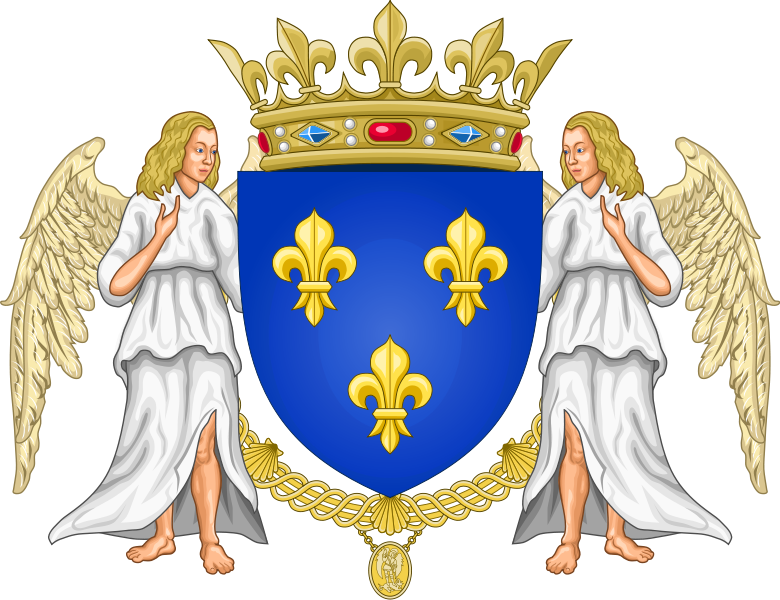
1024 House of Valois


File:Royal Coat of Arms of Valois France.svg

////////////////////

The House of Valois[1] (French pronunciation: ​[valwa]) was a cadet branch of the Capetian dynasty. They succeeded the House of Capet (or "Direct Capetians") to the French throne, and were the royal house of France from 1328 to 1589. Junior members of the family founded cadet branches in Alençon, Anjou, Burgundy and Orléans.
The Valois descended from Charles, Count of Valois (1270–1325), the third son of King Philip III of France (reigned 1270–1285). Their title to the throne was based on a precedent in 1316 (popularly known in the English-speaking world as the Salic law), which excluded females (Joan II of Navarre) as well as male descendants through the distaff line (Edward III of England), from the succession to the French throne

 Valois Dynasty, the royal house of France from 1328 to 1589, ruling the nation from the end of the feudal period into the early modern age. The Valois kings continued the work of unifying France and centralizing royal power begun under their predecessors, the Capetian dynasty.

 he House of Valois was a branch of the Capetian family, for it was descended from Charles of Valois, whose Capetian father, King Philip III, awarded him the county of Valois in 1285. Charles’s son and successor, Philip, count of Valois, became king of France as Philip VI in 1328, and thus began the Valois dynasty. The house subsequently had three lines: (1) the direct line, beginning with Philip VI, which reigned from 1328 to 1498; (2) the Valois-Orléans branch, which consisted of one member, Louis XII (reigned 1498–1515), son of Charles, duc d’Orléans, a descendant of King Charles V; and (3) the Valois-Angoulême branch, beginning with Francis I, son of Charles, count of Angoulême, another descendant of Charles V; it reigned from 1515 to 1574 and was succeeded by the Bourbon dynasty, another branch of the Capetians.