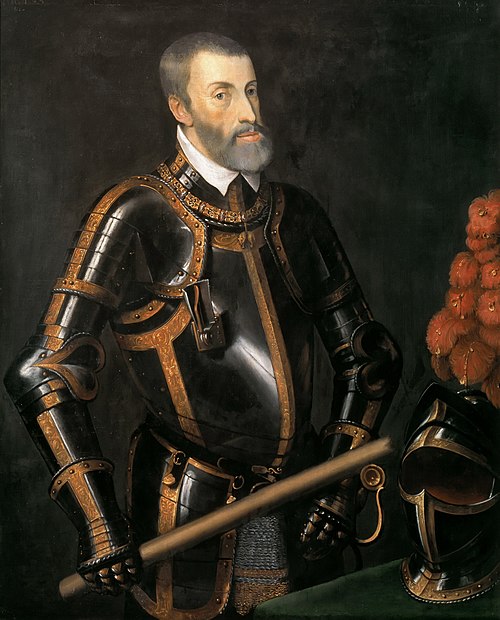
Philip II
(21 May 1527 – 13 September 1598)
Philip II, often considered to be one of the greatest of Spain’s monarchs, was the son of Charles V, Holy Roman Emperor and King of Spain and his cousin Isabella of Portugal, Philip was born on 21 May 1527 at the in the Palacio de Pimentel in Valladolid. It was by all accounts a difficult labour which his mother, Isabella, bore with stoicism. So conscious was she of bearing the heir to the Habsburg Empire, that when urged to cry out to ease her travail she responded “die I might, but cry out I will not”.
The young Philip was brought up at the court of Castile by his Portuguese mother, he grew very close to his sisters María and Joanna. He was described by the Venetian ambassador Paolo Fagolo in 1563 as “slight of stature and round-faced, with pale blue eyes, somewhat prominent lip, and pink skin, but his overall appearance is very attractive.” He added “He dresses very tastefully, and everything that he does is courteous and gracious.”
On 12 November 1543, the then sixteen year old Philip was married to his double first cousin Maria Manuela of Portugal, the daughter of John III of Portugal and Catherine of Austria . His father Charles V and his parents in law had chided Philip for his coldness toward Maria Manuela, Philip was by nature austere, cold and reserved. His coldness was in part due to his obsessive self-discipline. However, his correspondence with close family members reveal much warmth, in stark contradiction of his cold public image. Philip was short and slight in stature, invariably dressed in sober black, his sombre dress only relieved by the Order of the Golden Fleece, founded by his ancestor Philip the Good, Duke of Burgundy, which he habitually wore around his neck.
The marriage produced one child, the highly inbred Don Carlos, Prince of Asturias, who was born on 8 July 1545. Maria Manuela died some four days later from a postpartum haemorrhage. Carlos was deformed at birth and grew to be a mentally unstable character.
A second marriage was arranged for Philip to his 37 year old maternal cousin once removed, Mary I of England the only daughter of Henry VIII and Philip’s great aunt Catherine of Aragon. To raise Philip to the same rank as Mary, Charles V ceded the crown of Naples, as well as his claim to the Kingdom of Jerusalem, to his son. Mary had succeeded to the throne of England in 1553 on the death of her Protestant half-brother, Edward VI. There were several attempts by England’s Protestant element to overthrow the new Catholic queen, which led Mary to the decision to form an alliance with Catholic Spain, a decision which was unpopular with the English, who strongly disliked the idea of having a foreign king.
Following the execution of Mary’s Protestant rival, Lady Jane Grey, Philip duly arrived in England and the marriage was celebrated in July 1554 at Winchester Cathedral, Philip was eleven years younger than his bride. Philip and Mary appeared on coins together, with a single crown suspended between them as a symbol of joint reign. Mary, who had known little affection since her mother’s death, was in love for the first time in her life at the age of thirty-seven. Philip, much younger than his bride, unfortunately did not reciprocate her affection. As Ruy Gomez noted ‘The Queen is a lady of quality, but older than we thought, but his Highness is behaving so well and gives so many gifts that I’m sure both will be very pleased with each other, the king is trying to be as friendly as possible, he believes that his marriage was not made for flesh, but for the restoration of this area and preservation of those states’ (Flanders).
Philip’s father, Charles V abdicated in 1555 and Philip became king of Spain, the Netherlands, and all Spanish dominions in Italy and America. Philip reactivated the Spanish Inquisition in an attempt to deal with the growth of Protestantism in Europe. Mary believed herself pregnant, but was humiliated when the desperately awaited child did not arrive at the due time and she had to accept that she had been mistaken. The Queen had in fact, suffered from a phantom pregnancy. Philip, never particularly enamoured of her, left England shortly after, leaving Mary desolate and deserted and pathetically yearning for his return.
Philip returned briefly to enlist England’s support in a war against France, which led to the loss of Calais, which had been an English possession since the conquests of Edward III, a source of great sadness to the Queen. She was reported to have said at the time “When I am dead and opened you will find Calais written on my heart.” Mary again believed herself pregnant of a child which would continue her work and ensure a Catholic succession. It turned out to be a tumour.
Philip, realizing that the succession of Mary, Queen of Scots to the English throne would be disadvantageous to Spain, since she was at that time married to the Dauphin of France, had to be avoided at all costs. He persuaded Mary to name Elizabeth as her successor and marry her to a Spaniard. Elizabeth resisted such a marriage and the Queen could not, in good conscience, force her to do so. Mary died, deserted again by her husband, on 17 November, 1558, of either uterine or ovarian cancer. On receipt of the news, Philip wrote “I felt a reasonable regret for her death.” .
Reluctant to sever his tie with England, Philip proposed marriage to England’s new sovereign, his sister-in-law, Elizabeth I , but his offer was diplomatically declined.

Philip married for a third time to Elisabeth of Valois, the pretty daughter of King Henri II of France in 1559. He was enchanted by his 14-year-old bride, and despite their age difference, Elisabeth wrote to her mother, that she considered herself to be fortunate to have married so charming a prince. The marriage produced the following issue:-
(ii) Isabella Clara Eugenia of Spain, (12 August 1566 – 1 December 1633), who married Albert VII, Archduke of Austria, had three children, all of whom died in infancy
/////////////////////////